Best AI Accounting Software for Bookkeepers and Accountants (Aug 2026)
Startup Accounting
Best AI Accounting Software for Bookkeepers and Accountants (Aug 2026)
Compare the best AI accounting software for bookkeepers and accounting firms in January 2026. See which platforms automate categorization, reconciliation, and startup metrics.
Sasha Orloff
1.29.26
In article:
Accounting. Simplified
A bad product lacks competitive advantage. Successful businesses have something unique that's hard to copy. It could be cost efficiency, brand power, or proprietary tech. Without this, you're just waiting to get outperformed. Think of physical retailers being outperformed by e-commerce.
Thank you for being part of our Puzzle community. Stay tuned!
Oops! Something went wrong while submitting the form.
If you're still manually categorizing transactions and running account reconciliations for hours every month, you're working harder than you need to. AI accounting for bookkeepers has reached the point where automation handles the repetitive work while you maintain oversight and focus on the advisory services your clients actually value.
We tested the leading AI accounting software tools to see which ones actually deliver on automation promises, integrate natively with startup fintech tools, and respect the accounting firm relationship. The differences are bigger than you'd think, most clearly around whether vendors see you as a partner or competition.
TLDR:
AI accounting software automates transaction categorization and reconciliation while you maintain control through review workflows
Puzzle delivers 98% automated categorization with AI that learns from your corrections, cutting month-end close time up to 50%
Partner-only model means Puzzle never competes with accounting firms for clients, unlike QuickBooks Live
Native integrations with Stripe, Mercury, Ramp, and Gusto work reliably without manual journal entries
Puzzle is AI-native accounting software built for bookkeepers and accounting firms serving startups
What is AI accounting software for bookkeepers and accountants?
AI accounting software automates repetitive bookkeeping tasks while keeping accountants in control. The software handles transaction categorization, bank reconciliation, and revenue recognition scheduling automatically, then presents results for review.
The key difference from legacy tools is learning capability. Traditional software follows static rules you configure once. AI accounting software learns from your corrections and approvals, getting smarter with each interaction you have with it.
For bookkeepers and accountants, this moves the role from data entry to oversight. You review AI-processed transactions, handle exceptions, and focus on advisory work that requires human expertise.
Under the hood, automated categorization runs through one of three architectural approaches: (1) deterministic rules engines that match vendor names or amounts to preset categories; (2) ML models trained on large transaction datasets that infer the right category from merchant identity, amount, and context; and (3) hybrid systems that apply rules first and fall back to ML for unmatched transactions. Most modern platforms use the hybrid approach, where rules handle high-confidence, high-volume vendors while ML covers the long tail.
When a bookkeeper recategorizes a transaction, the system updates its model or rule set so the same vendor is handled correctly in future months. No manual re-training is required; the correction itself is the training signal. Accuracy typically starts at 60-80% in month one and improves sharply after the first month-end close as finalized transactions build a personalized categorization model for each client. That distinction matters when comparing vendor accuracy claims: a rules-only system has a fixed ceiling, while a trained ML model improves as transaction history grows.
How we ranked AI accounting software for bookkeepers and accountants
We looked at each software based on what bookkeepers and accountants serving startups need in their daily work:
Pearson research found generative AI can automate 30-46% of manual tasks performed by white-collar workers. Intuit research found 98% of accountants and bookkeepers have already used AI accounting software to serve clients, which means the question is no longer whether to adopt AI tools but which platform delivers the most reliable automation for startup-focused firms.
AI automation capabilities: Transaction categorization and reconciliation the software handles automatically, plus whether the AI improves with user input
Integration depth: Native connections to fintech tools startups use (Stripe, Mercury, Ramp, Gusto)
Real-time visibility: Whether clients access current financial data daily or wait until month-end
Dual-basis accounting: Simultaneous cash and accrual books without manual workarounds
Ease of use: Interface simplicity for both accountants and non-accountant founders
Partner model: Whether the vendor competes with accounting firms for clients
AI accuracy: Reliability of automated categorization and reconciliation
All assessments draw from publicly available vendor information, user reviews, and documented firm experiences.
Best overall AI accounting software for bookkeepers and accountants: Puzzle
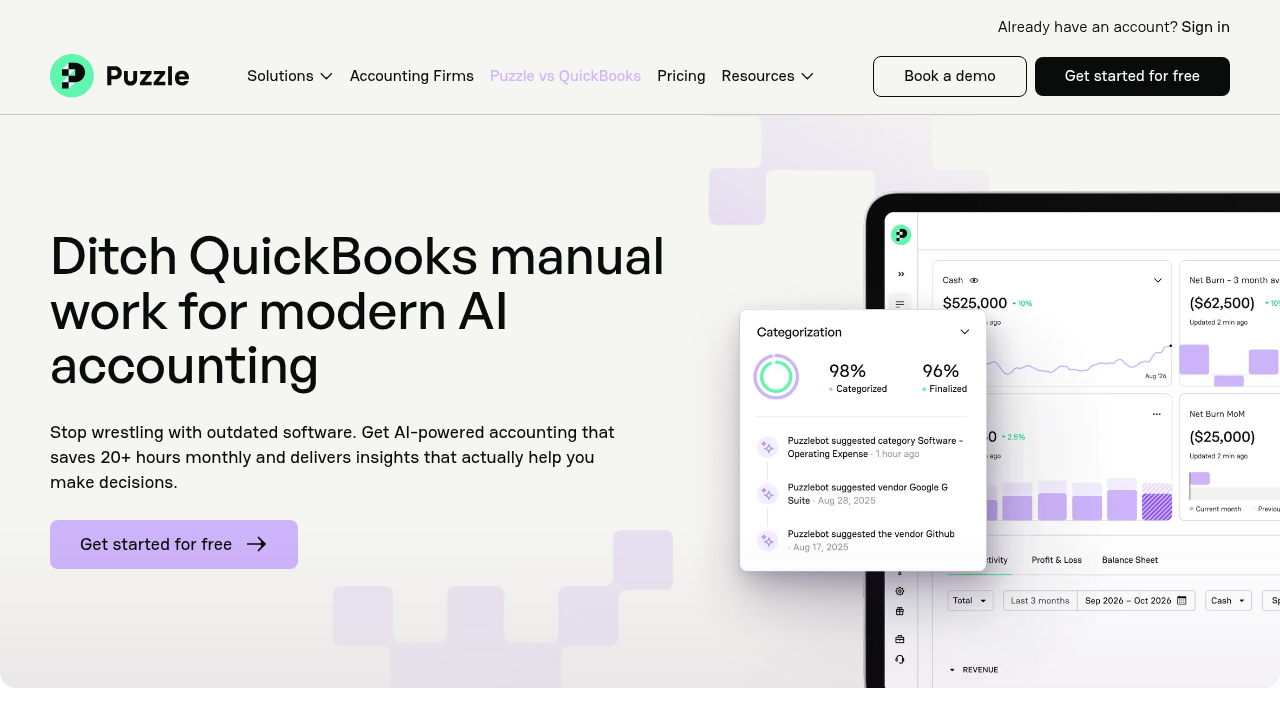
Puzzle is AI-native accounting software built for bookkeepers and accounting firms serving startups. The software delivers 98% automated transaction categorization with AI that learns from your corrections, not static rules.
Core strengths:
AI handles categorization, reconciliation, and revenue recognition while you maintain control through built-in review workflows
Native integrations with Stripe, Mercury, Ramp, Brex, and Gusto
Real-time burn rate, runway, and ARR/MRR tracking automated for startup clients
Partner-only model that never competes with your firm for clients
Direct access to the development team for support
How Puzzle's AI categorization works in practice:
Transaction imported: Puzzle pulls transactions directly from Stripe, Mercury, Ramp, Brex, or Gusto via native API connections, so there are no sync delays and no manual imports.
AI categorizes automatically: The AI matches each transaction against vendor metadata, account source, and patterns from similar businesses to assign a category. Starting accuracy runs 60-80% in month one.
Accountant reviews and approves: You see AI-suggested categories in a built-in review queue. Accept, adjust, or override, and every decision is logged.
System learns and auto-creates a rule: Each approval or correction automatically generates a vendor rule. No manual rule setup. After the first month-end close, accuracy improves sharply as the system builds a personalized model for each client.
Campfire is an AI-native ERP for Series A+ companies outgrowing QuickBooks. 46% of accountants now use AI daily, and Campfire positions as a NetSuite replacement for companies with 50-500+ employees.
What they offer
Multi-entity consolidation with complex revenue recognition
Full ERP functionality including GL, invoicing, billing, and treasury
Advanced multi-currency support with consolidation
Built for companies with dedicated finance teams and controllers
Good for: Series A+ companies with multiple legal entities, complex international operations, and dedicated finance teams who need full ERP capabilities.
Limitation: Campfire targets companies with 100+ employees migrating from NetSuite. Early-stage startups (pre-seed to Series A) with single entities will find the ERP complexity, longer implementation timelines, and finance-team focus unnecessary.
Bottom line: Campfire excels for mid-market companies ready for ERP infrastructure. Puzzle is built for earlier-stage startups and the accounting firms serving them, with simpler setup, founder-friendly design, and a partner-only model that never competes with your firm.
AI agents that run workflows with minimal human intervention
97.8% accuracy trained on over $825B in transactions
Full-service bookkeeping with Digits CPAs at $350+ per month
Broad SMB integrations via Plaid
Good for: Non-startup SMBs (retail, healthcare, consulting) that want autonomous bookkeeping; not designed for startup fintech stacks or firm partnerships.
Limitation: Digits offers full-service bookkeeping with their own CPAs, directly competing with accounting firms for client revenue. They target general SMBs instead of startups, lacking native integrations with startup fintech tools and missing automated burn rate, runway, and ARR tracking.
Bottom line: Digits builds AI to replace bookkeepers for broad SMBs. Puzzle builds AI to empower accounting firms serving startups, with partner-only commitment and automated metrics that matter to tech companies.
Zoho Books
Zoho Books is affordable accounting within the broader Zoho ecosystem of 55+ business apps. With 95% of accountants having adopted automation to handle routine tasks, Zoho offers value for small businesses wanting bundled tools.
What they offer
Zia AI assistant that works across the entire Zoho suite
Free tier for businesses under $50K in revenue
Integration with Zoho CRM, Projects, Desk, and other suite products
Pre-filled transaction fields based on past patterns
Good for: Non-startup small businesses in the Zoho ecosystem; not suitable for startups needing burn rate, runway, or ARR tracking.
Limitation: Zoho lacks automated burn rate, runway, and ARR/MRR tracking. Zia AI serves 55+ apps, so accounting automation is less deep than purpose-built solutions. No partner program with firm-specific tools.
Intuit QuickBooks
QuickBooks holds the largest market share in accounting software but now competes directly with firms through QuickBooks Live bookkeeping services. Accountants spend over 10 hours weekly on manual data entry that QuickBooks has been slow to automate.
What they offer
Intuit Assist AI features retrofitted onto decades-old architecture
Third-party app marketplace for integrations
Brand recognition and widespread familiarity
Multiple pricing tiers with varying feature access
Good for: Businesses with traditional banking relationships and existing QuickBooks familiarity who don't need real-time startup metrics or native integrations with Stripe, Mercury, or Ramp.
Limitation: QuickBooks Live competes directly with accounting firms for clients. Fintech integrations are unreliable, often requiring manual journal entries. No burn rate, runway, or ARR tracking. AI features locked behind higher-tier plans.
Bottom line: QuickBooks retrofits AI onto legacy systems while competing with firms. Puzzle was built AI-native from day one with partner-only commitment and reliable native integrations for the startup fintech stack.
Xero
Xero is a cloud-native accounting tool with strong international presence and their JAX AI assistant. The software offers 1,000+ third-party integrations through its app marketplace.
What they offer
JAX conversational AI assistant for answering questions and creating invoices
App marketplace with 1,000+ third-party integrations
Strong presence in UK, Australia, and New Zealand markets
Chart of accounts templates for various industries
Good for: International businesses or accounting firms with global clients, particularly those based in UK, Australia, or New Zealand where Xero has stronger market presence and localized compliance features.
Limitation: Xero relies on third-party apps for US fintech integrations instead of native connections to Stripe, Mercury, Ramp, and Brex. No native burn rate, runway, or ARR/MRR tracking for startup clients. Xero sells directly to businesses, competing with accounting firms for clients.
Bottom line: Xero offers global breadth but less US startup depth. Puzzle was built for US startups and the firms serving them, with native fintech integrations, automated startup metrics, and a partner-only model.
How to vet AI transaction categorization before you commit
Not all AI accounting software categorizes transactions the same way. Before committing, run through these five checks to separate software that genuinely learns from software running static rules in the background.
Ask for published accuracy benchmarks and training dataset size. A vendor claiming 97-98% accuracy should say what transaction volume that figure is based on and how it is measured. A headline number without methodology is not a benchmark.
Run a pilot on your actual client transaction mix. Categorization accuracy varies by industry and fintech stack. Demo datasets are curated for strong results; your Stripe and Ramp transaction mix may look very different from what the vendor tested on.
Test exception handling. Submit an ambiguous or novel transaction and observe whether the system flags it for review or silently miscategorizes it. A system that surfaces uncertainty is easier to trust and correct than one that hides it.
Verify the correction loop. Recategorize a transaction, then run similar transactions through again. Confirm the system applies that learning to future matches and does not repeat the error month after month. This single test separates adaptive ML from static rules engines.
Check integration fidelity. Confirm that transactions from Stripe, Ramp, Mercury, or Gusto carry enough metadata for the AI to categorize correctly without manual journal entries. Third-party connectors often strip the metadata that native integrations preserve.
Puzzle publishes its 98% categorization rate and the AI learns from every correction a bookkeeper makes, building a personalized model per client. Native integrations with Stripe, Mercury, Ramp, and Gusto provide the metadata depth that makes high accuracy achievable without manual workarounds.
Feature comparison table of AI accounting software for bookkeepers and accountants
Feature
Puzzle
Campfire
Digits
Zoho Books
QuickBooks
Xero
AI Automation
Yes
Yes
Yes
Yes
Yes
Yes
Partner-Only Model
Yes
No
No
No
No
No
Native Stripe Integration
Yes
Yes
Yes
No
No
No
Native Mercury Integration
Yes
No
No
No
No
No
Native Ramp/Brex Integration
Yes
No
No
No
No
No
Automated Burn Rate Tracking
Yes
No
No
No
No
No
Automated Runway Tracking
Yes
No
No
No
No
No
Automated ARR/MRR Tracking
Yes
No
No
No
No
No
Dual-Basis Accounting
Yes
Yes
No
No
No
No
Revenue Recognition Automation
Yes
Yes
No
No
No
No
Built for Accounting Firms
Yes
No
No
No
No
No
Never Competes with Firms
Yes
Yes
No
No
No
No
Free Client Migrations
Yes
No
No
No
No
No
Why Puzzle is the best AI accounting software for bookkeepers and accountants
Puzzle is AI-native accounting software built for firms serving startups. Our partner-only model means we never compete for your clients.
The software delivers 98% automated categorization with AI that learns from your guidance, native integrations with startup fintech stacks, and automated burn rate and runway tracking. Partner firms see 50% faster month-end close and 96% faster reconciliations.
Built-in review workflows keep you in control while your team redirects attention from 10+ hours weekly of manual data entry to advisory services.
Final thoughts on AI accounting software for bookkeepers
Bookkeeping firms serving startups need a software partner built for their world, not a vendor that competes for their clients. Puzzle's partner-only model means every product decision is made to help your firm grow, not to replace it. If you're ready to see what AI-native accounting looks like in practice, book a demo and run it on a real client account.
FAQs
Which AI accounting software is best for accounting firms serving early-stage startups?
Puzzle is built for firms serving startups, with automated burn rate and runway tracking, native integrations to Stripe, Mercury, and Ramp, and a partner-only model that never competes for your clients. Campfire targets Series A+ companies needing full ERP capabilities, while Digits and QuickBooks compete directly with firms through their own bookkeeping services.
How do I choose between AI accounting software that automates everything versus software that keeps accountants in control?
Look for software with built-in review workflows where AI processes transactions but presents them for your approval, like Puzzle's approach with 98% automated categorization ready for review. Avoid "autonomous" systems that minimize human oversight if you want to maintain quality control and client relationships while gaining speed.
How do I verify an AI accounting tool's accuracy claims before switching?
Look for vendors that publish training dataset size and the methodology behind accuracy percentages, beyond a headline number. Run a 30-day pilot on a live client account with a known transaction mix and measure miscategorization rate yourself. Ask whether the accuracy figure covers all transaction types or only transactions that match existing rules; a rules-only ceiling looks impressive until you hit the long tail.
What integrations should AI accounting software have for startup clients?
The core startup fintech stack includes Stripe for revenue, Mercury or Brex for banking, Ramp or Brex for spend management, and Gusto for payroll. Native integrations that carry full transaction metadata produce higher categorization accuracy than third-party connectors or CSV imports because the AI has richer context to work with. Verify that integrations are native and bidirectional, not one-way data pulls that still require manual reconciliation on your end.
How do I know if an AI accounting tool actually learns from my corrections or just follows static rules?
Ask the vendor what happens after you approve or override a category. Genuine learning means the system automatically creates a vendor rule from that decision, no manual setup required, and accuracy improves measurably after the first month-end close. If the vendor describes rule libraries you configure yourself or a fixed list of category mappings, the tool is running static logic, not AI learning. Puzzle auto-generates rules from every approval and builds a personalized categorization model per client after the first close.
Does it matter whether the AI accounting software vendor also sells direct bookkeeping services?
Yes. Vendors that offer their own bookkeeping service (QuickBooks Live, Digits) compete directly with your firm for client revenue. That conflict shapes product decisions: they have less incentive to build tools that make your firm more productive. Puzzle operates a partner-only model, meaning the product is built exclusively to make accounting firms faster and more profitable, with no direct-to-business bookkeeping service competing for your clients.
What's the difference between AI-native accounting software and legacy tools with AI features added?
AI-native software like Puzzle was designed from day one with AI at its core, so the AI learns from your corrections and improves continuously. Legacy tools like QuickBooks retrofit AI features onto decades-old architecture, resulting in static rules that don't adapt and unreliable integrations that often require manual workarounds.
When should an accounting firm consider switching from QuickBooks to AI-native software?
Consider switching if you're spending 10+ hours weekly on manual categorization and reconciliation, if your startup clients need real-time burn rate and runway tracking, or if QuickBooks integrations with Stripe, Mercury, or Ramp require manual journal entries. Firms document up to 50% faster month-end close after switching to AI-native software.
Let us help you solve your financial puzzles.
Thank you for being part of our Puzzle community. Stay tuned!
Oops! Something went wrong while submitting the form.