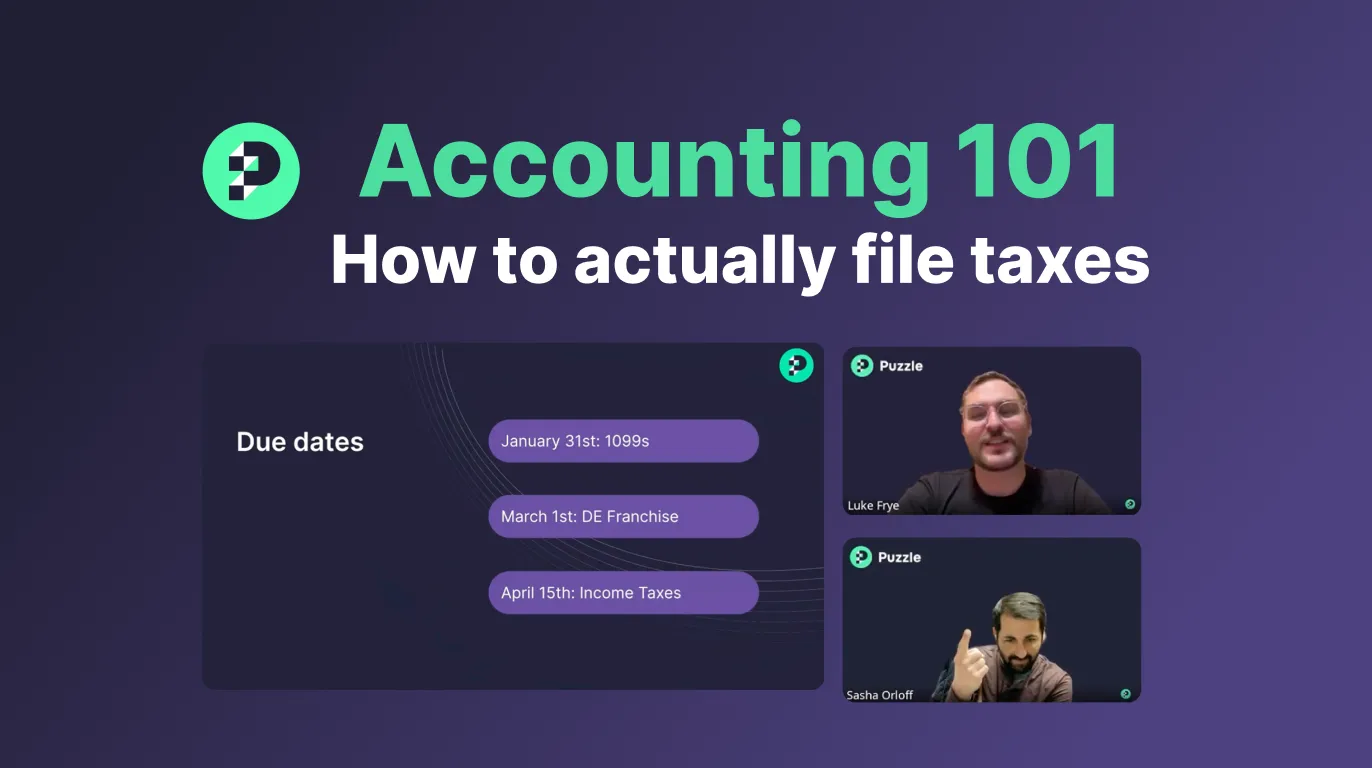
The April 15th tax deadline is approaching… so let’s just answer the hard questions.
How do you actually file taxes as a founder?
Welcome to Accounting 101: the series that teaches startup founders how to tackle their own accounting, without a hassle or big time commitment.
Today, we're covering tax filing for founders - what's required, the types of taxes, and how to manage them effectively.
TLDR:
This lesson will cover:
The tax filings you need to comply with, such as:
Important upcoming deadlines and how to prepare for them:
The best tools to make tax season a breeze.
| Tax Type | Who It Applies To | Key Deadline |
|---|---|---|
| Income Taxes | All founders / entities | April 15 (or Sept 15 for extended S-corps & partnerships) |
| Delaware Franchise Tax | Delaware-registered companies | March 1 |
| Sales Taxes | Founders selling taxable goods/services | Varies by state |
| Franchise Taxes | Entities registered in applicable states | Varies by state |
| State Registrations | Founders operating across multiple states | Varies by state |
If you're reading this today (September 15, 2026), you're hitting one of the quieter-but-real deadlines on the calendar: extended returns for S-corps and partnerships are due today. If you filed for a tax extension back in March and haven't submitted yet, the clock runs out tonight.
Beyond today's deadline, a few 2026 developments are worth knowing:
Tax law moves fast. The frameworks in this post hold (income taxes, franchise taxes, sales taxes, state registrations), but the specific numbers and forms shift every year. When in doubt, verify with a CPA before you file.
If you paid a business expense out of pocket (a flight, a client dinner, a software subscription on your personal card), getting it onto your books accurately is what matters. Your CPA will need the amount, the date, the business purpose, and a receipt: the earlier you log it, the less you're reconstructing from memory in April.
In Puzzle, you can upload receipts and log personal transactions directly in the app, then categorize them as founder reimbursements. That creates a clean paper trail: the expense hits the right account on your books, it's backed by a receipt, and you (or your CPA) can pull the full record at tax time without digging through email. Log it as you go and your tax prep becomes a review, not a rescue operation.
If you’re ready never to worry about tax season accounting again, Luke (me!) your resident CPA is on standby to help. Sign up for Puzzle and reach out to me in-app to book an onboarding call.